What actually causes the crash-test dummy to go flying off the truck bed the instant the truck hits the pole?
Meet Inertia
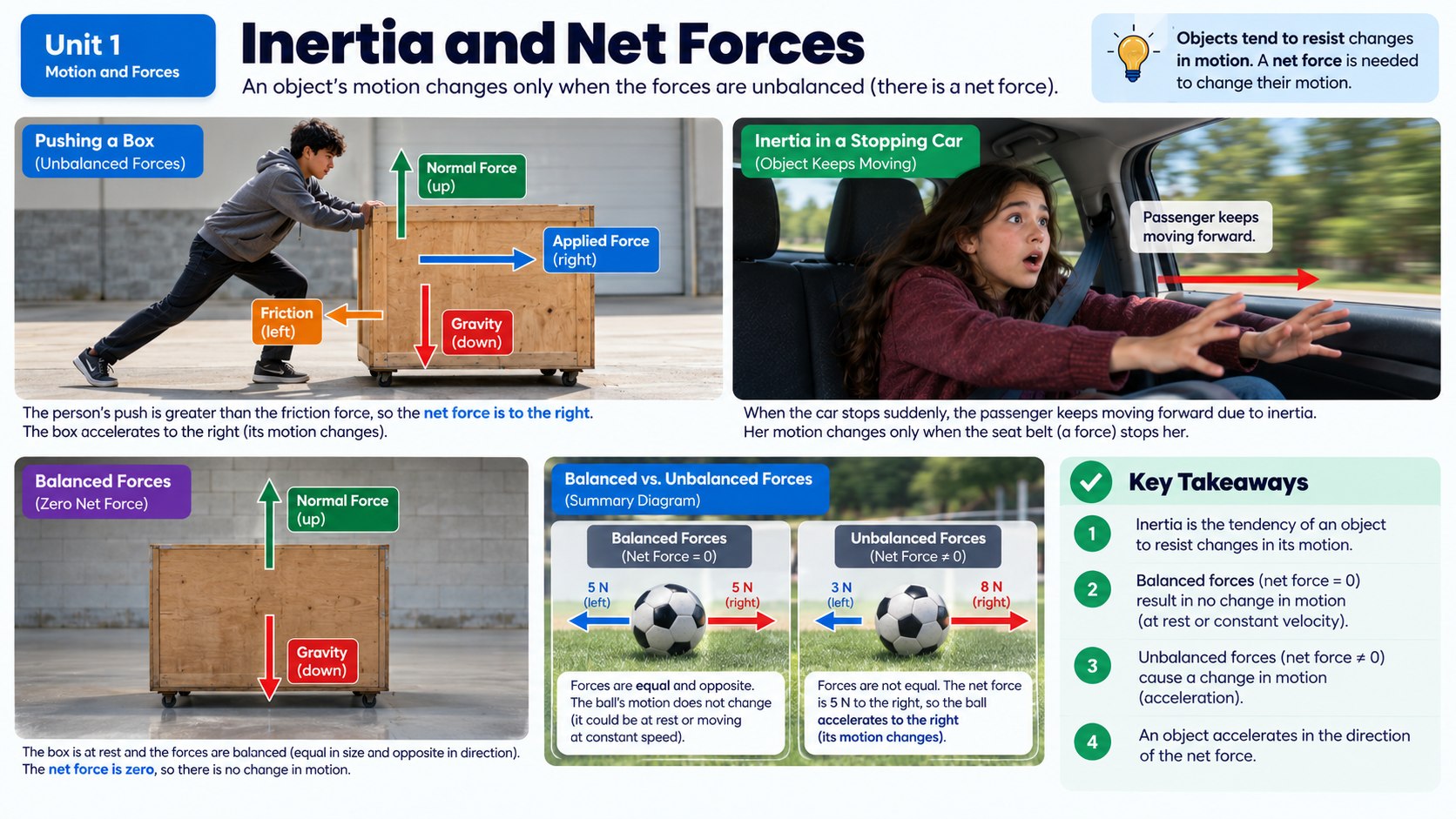
Every object in the universe has a property called inertia: the tendency of an object to keep doing whatever it's already doing — staying still if it's still, or continuing to move in a straight line at a steady speed if it's moving — unless something pushes or pulls on it to change that. Inertia isn't a force itself; it's more like an object's built-in stubbornness about changing its motion.
When the crash-test dummy is sitting in the open truck bed while the truck speeds along, the dummy is moving forward at the same speed as the truck. Its inertia means it "wants" to keep moving forward at that same speed, in that same straight line, unless some force acts on it to slow it down or change its path.
It's easy to accidentally think of inertia as some kind of force pushing or pulling on an object, but that's a common misconception worth clearing up. Inertia isn't a force at all — it's a property, like mass or color, that every object simply has. A force is something that acts on an object from the outside, like a push from an engine or a pull from gravity. Inertia, on the other hand, describes what an object will keep doing if no outside force acts on it. Saying "inertia pushed the dummy forward" isn't quite right; it's more accurate to say "nothing pushed on the dummy, so it kept moving forward on its own," which is really just Newton's first law of motion in action.
What Happens When the Truck Suddenly Stops
The instant the truck crashes into the pole, the truck itself experiences a huge force from the pole that brings it to a screeching halt. But the dummy is a separate object, only loosely resting on the truck bed — nothing is gripping it or strapping it down. Because of inertia, the dummy keeps moving forward at its original speed, right past the point where the truck stopped. From the dummy's point of view, it just keeps going in a straight line — it's the truck that suddenly disappeared out from under it. That's exactly why the dummy flies off the back: not because some mysterious force throws it forward, but because nothing stopped it from continuing to do what it was already doing.
You can see the same idea play out with anything loose inside a vehicle, not just a crash-test dummy. A cell phone sitting on the dashboard, a coffee cup in a cupholder, or a backpack on the back seat all have their own inertia too. During a sudden stop, every one of these objects keeps moving forward at the car's old speed unless something restrains it — which is exactly why an unsecured phone can go flying into the windshield area during even a moderate stop. The size of the object doesn't change the basic rule, only how dangerous the result is: a flying phone is a nuisance, but a flying passenger, or a heavy unsecured object like a toolbox in a truck bed, can be deadly. That's the real reason traffic safety campaigns tell people to secure loose cargo, not just passengers.
Mass, Inertia, and Net Force
Not all objects resist changes to their motion equally. The greater an object's mass — the amount of matter it's made of — the greater its inertia, meaning it takes a bigger force to speed it up, slow it down, or change its direction. A loaded moving truck has far more inertia than a skateboard, which is why it's so much harder to stop.
To actually change an object's motion, you need an unbalanced, or net, force acting on it. Forces are pushes or pulls, and objects often have multiple forces acting on them at once. When those forces cancel each other out completely, they're called balanced forces, and the object's motion doesn't change at all. But when the forces don't cancel out, there's a net force, and that net force is what changes an object's speed or direction. The seatbelt in a real car provides exactly this kind of net force on a passenger during a crash — pulling backward on them so they slow down along with the car, instead of continuing forward like our unfortunate crash-test dummy.
Inertia at Every Scale
Inertia doesn't only apply to trucks and crash-test dummies — it applies to literally everything with mass, from a speck of dust to an entire planet. A dust particle floating in still air has so little mass, and therefore so little inertia, that even a faint breath can send it tumbling in a new direction. A loaded cargo ship, on the other hand, has so much inertia that it can take several kilometers of open water just to come to a complete stop after its engines shut off, even though the water itself is constantly producing some friction to slow it down.
Out in space, where there's no friction or air resistance to interfere, inertia becomes even more obvious: a spacecraft that fires its engines for a few seconds to speed up will keep coasting at that exact speed, in that exact direction, for years, with no additional force needed to keep it going. Thinking about inertia at these very different scales — from dust to spacecraft — helps show that it isn't a special rule just for car crashes. It's one of the most universal ideas in all of physics.
Real-World Connections
Roller Coaster Restraints
The over-the-shoulder harness on a roller coaster exists because of inertia: when the coaster suddenly changes direction, your body wants to keep moving in a straight line unless something forces it to change course.
The Tablecloth Trick
Pulling a tablecloth out fast enough can leave the dishes sitting in place — their inertia keeps them from moving with the cloth during that split second.
Meet the Scientist
Amusement Park Ride Safety Engineers
These engineers spend years testing restraint systems before a single rider ever climbs aboard. They calculate exactly how much force a harness needs to withstand during the fastest drop or sharpest turn, using crash-test dummies and computer models similar to the ones automotive safety engineers rely on.
Key Vocabulary
Bold, underlined words in the reading above are clickable too — tap one to see its definition pop out. Or click or tap a card below to reveal the definition.
Explore More
Chapter Review
1. What is inertia?
2. Why does the crash-test dummy fly off the truck bed when the truck suddenly stops?
3. How does mass relate to inertia?
4. What is a net (unbalanced) force?
5. How does a seatbelt help a passenger during a sudden stop?
California Science Test (CAST) Practice
During an emergency stop test, a sedan and an SUV each apply the exact same braking force. Sensors recorded each vehicle's mass and the deceleration (the rate at which its speed decreased) that resulted from that identical braking force.
| Vehicle | Mass (kg) | Braking Force (N) | Deceleration (m/s²) |
|---|---|---|---|
| Sedan | 1200 | 6000 | 5.0 |
| SUV | 2400 | 6000 | 2.5 |
Which claim is best supported by the data in the table?